
You can have the perfect keywords, the fastest page speed, and the best backlinks. But if AI algorithms think you run a trucking company when you actually build websites, you are invisible.
That isn't a hypothetical scenario. It literally happened to me.
I’m Anshuman Singh, the owner of Expertineer. I am a developer, not a "guru." I believe that in 2026, being real is the new SEO.
Recently, I audited my own site to see how it looked to new AI search engines (like ChatGPT, Gemini, and Perplexity). I found a critical "Entity" error that was killing my organic reach.
My site was using a template that labeled my services as "Transportation" and "Robotics" in the code. To a human, it looked like a design glitch. To an AI, it was a fundamental conflict of identity.
We are entering the era of AEO (Answer Engine Optimization) and GEO (Generative Engine Optimization).
In this guide, I will show you exactly how I fixed this error. We will cover the specific steps you can take to increase your AI visibility right now.
Let's look at the this Code
Why Traditional SEO is Failing in the AI Era
Before we fix your site, you need to understand why your old strategy isn't working.
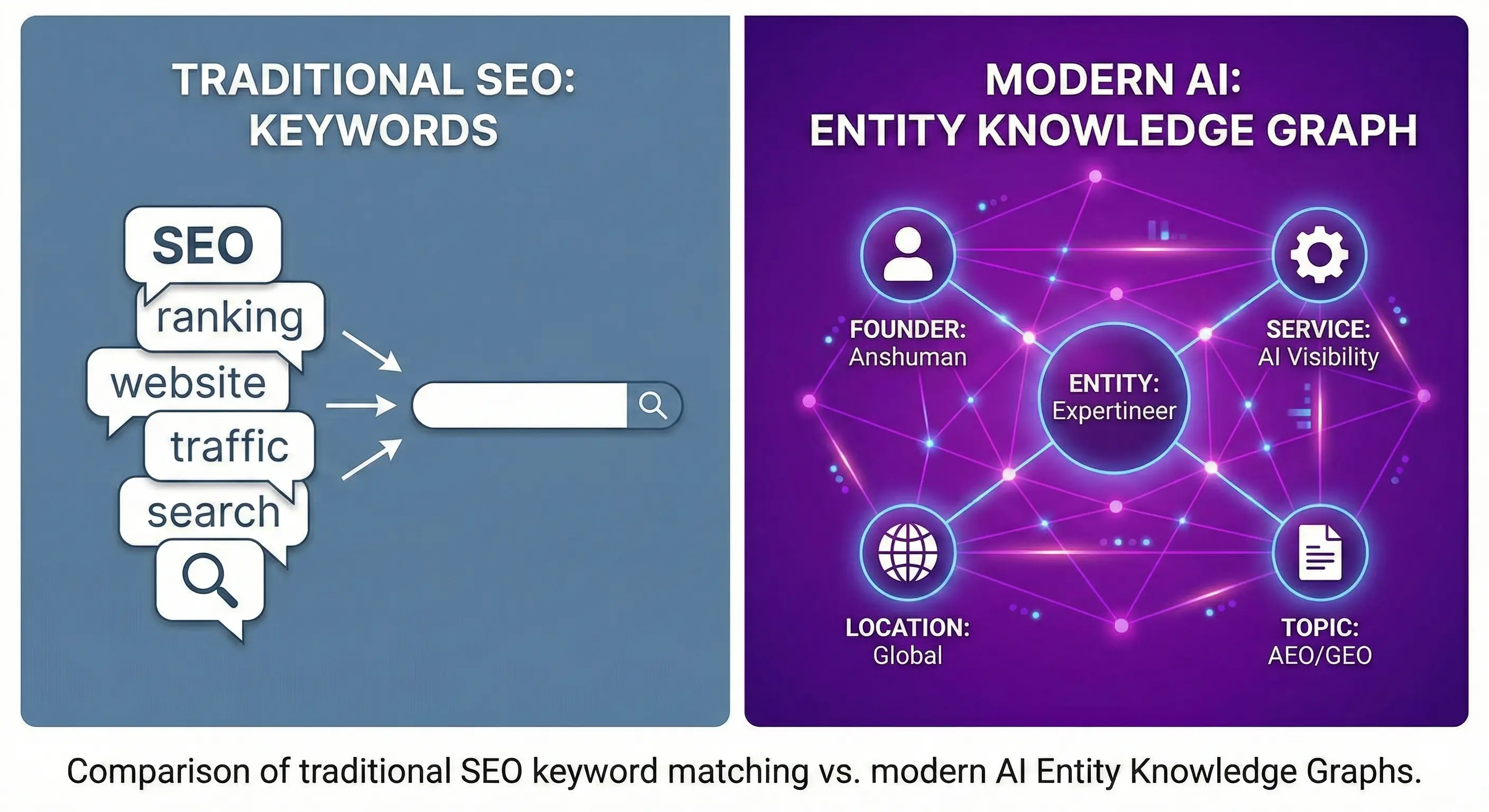
Large Language Models (LLMs) do not read websites like the old Google bot did. They don't just count keywords. They build a Knowledge Graph.
The Shift from Keywords to Entities
- Old SEO: Matches strings of text. (e.g., "Best SEO agency Jaipur")
- New AEO: Understands relationships between concepts. (e.g., "Anshuman Singh [IS A] Developer [WHO FOUNDED] Expertineer.")
If you want to appear in an AI Overview or a ChatGPT answer, you must stop feeding the engine "keywords." You must start feeding it Entities.
According to Google’s guide on Generative AI Search, the system prioritizes information backed by expert consensus and clear authorship.
If your entity data is messy—like mine was—the AI loses trust. When AI loses trust, it excludes you from the answer entirely.
Case Study: The "Transportation" Error That Made Me Invisible
I want to be transparent about this because authenticity is a ranking factor.
I ran a semantic audit on expertineer.com. I wasn't looking for broken links; I was looking at how machines interpret my content.
Buried in my service cards on the homepage, I found placeholder text from a template I used.
- Under my "SEO" service, the code said "Transportation."
- Under "AEO," it said "Robotics."
Why This Killed My Visibility
To a human user, these were just random words. But to a Google bot or AI crawler, this was a massive red flag:
- Site claims to do Web Development.
- Site also claims to do Logistics and Robotics.
- Analysis: Inconsistent Data. High probability of spam.
- Action: Do not cite in AI answers.
How to Increase Your AI Visibility (Step-by-Step Guide)
The solution isn't to write more blog posts. It is to fix your Entity Data.
Here is the exact roadmap I am using to fix Expertineer. Follow these steps to audit and repair your own site.
Step 1: Define Your "Who" (The Founder's Entity)
AI models trust people more than faceless corporations. If your "About Us" page says "We are a team of passionate individuals," you are failing the E-E-A-T test.
Action Items:
- Update your Bio: Explicitly link the brand to a real person.
- State your Role: I changed my bio to: "Founded by Anshuman Singh, a Python Programmer and Web Developer."
- Link your Profiles: Add links to your LinkedIn or GitHub to prove you exist elsewhere on the web.
Step 2: Speak "Robot" with JSON-LD Schema
This is the most critical step for increasing AI visibility. You cannot just write who you are in English; you have to code it in JSON-LD.
JSON-LD is invisible code that sits in the header of your website. It explicitly tells search engines what you are.
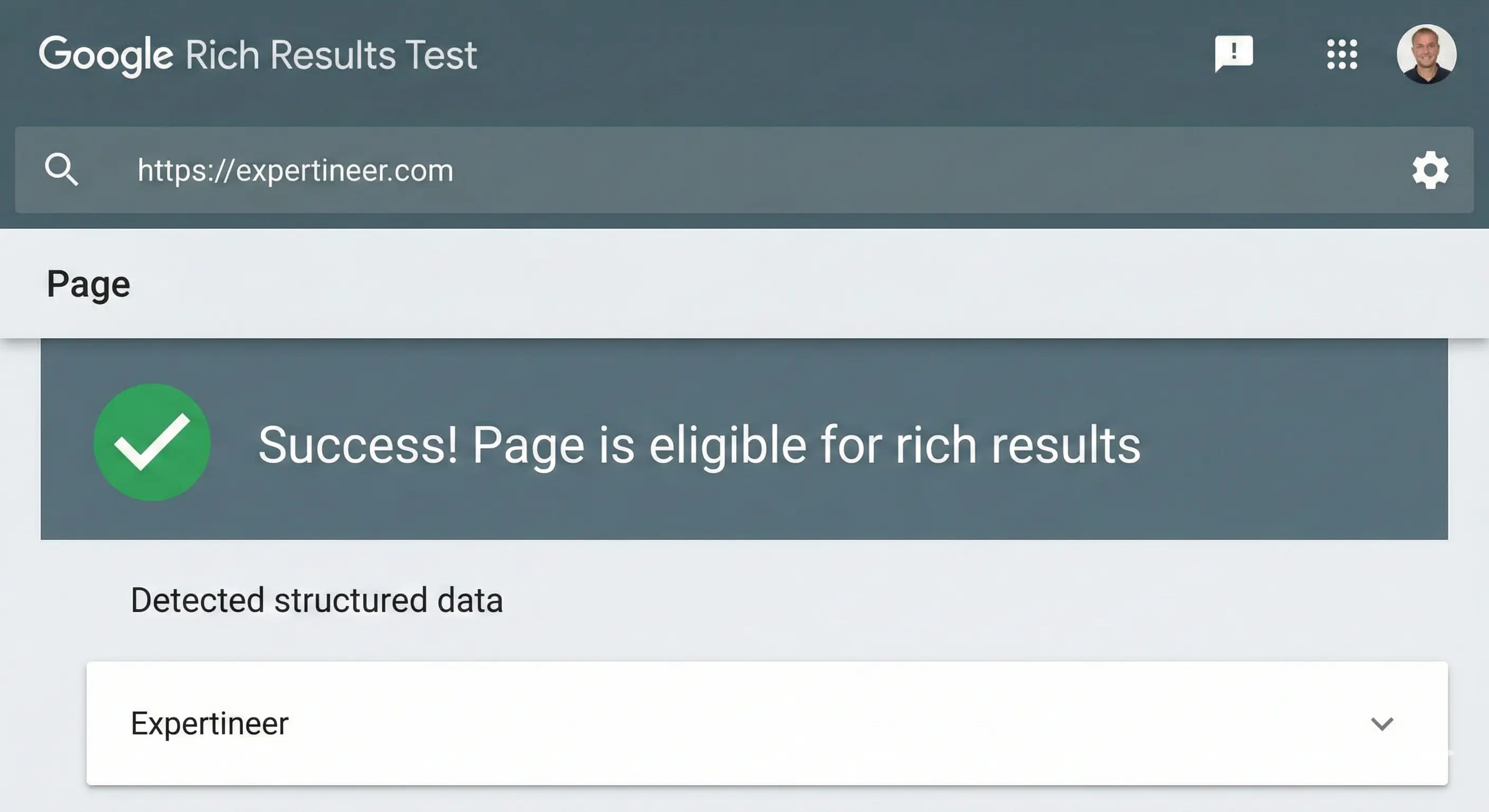
Developer Note: Don't guess at this code. Use the Google Rich Results Test to validate your schema.
Step 3: Optimize Content for "Answer Engines" (AEO)
AI chatbots are Question/Answer machines. Your content needs to match that format.
I am reformatting my service pages to directly answer the user's intent.
The "Inverted Pyramid" Method:
- Direct Answer: Start with the "What" and "How" immediately (like I did in this blog).
- Supporting Data: Add the technical details after the answer.
- Context: Add the history or background last.
This structure makes it easy for Gemini or ChatGPT to "scrape" your answer and serve it to their users.
Conclusion: Be Real, Get Found
The days of tricking the algorithm are over. The new SEO isn't about keywords; it's about Identity.
I fixed the "Transportation" error. I stripped out the fake "Agency" fluff. I am standing here as a real developer helping real businesses.
If you want to survive the shift to AI search, check your own site.
Are you a clear, trusted entity? Or are you accidentally telling Google you drive trucks?